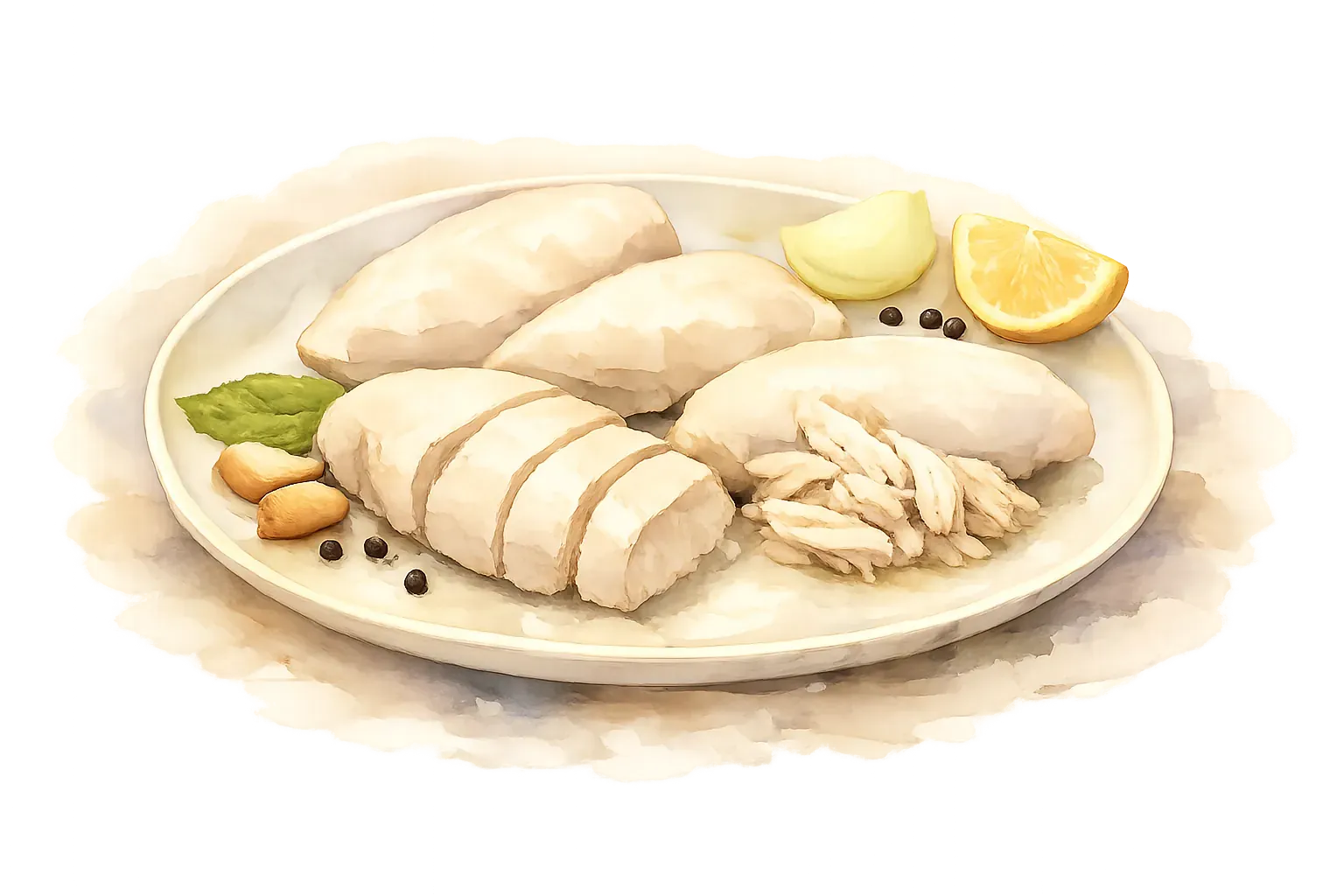
Poached Chicken Breasts
Tender, shreddable chicken for chicken salad, cooked by residual heat in a covered pot.
Ingredients
Tap one to check it off
Instructions
- Set up the pot: lay the chicken breasts in a single layer in a wide saucepan -- no stacking. Add the cold water (to cover the chicken by about 1 inch), kosher salt, peppercorns, bay leaves, garlic, onion, and lemon (if using). If any breast is thicker than about an inch, butterfly it first so everything cooks on the same clock.
- Heat the water to 175-180F: heat over medium and monitor the WATER, not the chicken. You want 175-180F -- shimmering, tiny bubbles clinging to the bottom, nothing breaking the surface. This is the ceiling the meat will approach, so overshooting into a boil is what actually toughens it.
- Cut the heat and cover: the moment the water hits temperature, turn the burner completely off and put the lid on. The pot now works like a crude sous vide bath and poaches the chicken as the meat climbs toward the water temperature while the water slowly falls.
- Steep, timed by thickness: time it by the THICKEST point of the breast, not its weight. 1/2 inch (pounded or butterflied): 8 to 10 minutes. 3/4 inch (small, 5-6 oz): 10 to 14 minutes. 1 inch (typical, 7-8 oz): 15 to 18 minutes. 1 1/2 inch or more (10-12 oz): 20 to 25 minutes. Heavy enameled or cast-iron pots hold heat and run at the short end of the range; thin aluminum runs long. Check at the SHORT end of your range -- the meat can't exceed the water temperature, so extra minutes cost almost nothing. Don't peek in the meantime; lifting the lid dumps heat and sets you back.
- Check for 150-155F: draw an instant-read thermometer slowly through the thickest part and watch for the LOWEST reading -- that's the true center. You want 150-155F. The meat has already spent many minutes in that range, so it's well past the hold time the USDA tables require.
- If under, reheat the bath: below 150F, don't wait it out -- the pot is cooling and won't get there on its own. Return to low heat until the water is back to about 175F, then cut the heat, re-cover, and give it 10 minutes before checking again. Skip this step entirely if the previous check came out in range.
- Rest in the liquid: leave the chicken submerged in the liquid off heat for 15 minutes. The temperature holds roughly flat rather than climbing, but the fibers relax and reabsorb moisture -- this does more for the final texture than anything else here.
- Cool, then shred or dice: cool to room temperature or colder, then shred with two forks for a softer salad or dice into 1/2-inch cubes for a chunkier one. Fold in mayo only once the meat is fully cool -- warm chicken breaks the emulsion and turns the salad greasy.
Ingredients
Tap one to check it off
Instructions
- Set up the pot: lay the chicken breasts in a single layer in a wide saucepan -- no stacking. Add the cold water (to cover the chicken by about 1 inch), kosher salt, peppercorns, bay leaves, garlic, onion, and lemon (if using). If any breast is thicker than about an inch, butterfly it first so everything cooks on the same clock.
- Heat the water to 175-180F: heat over medium and monitor the WATER, not the chicken. You want 175-180F -- shimmering, tiny bubbles clinging to the bottom, nothing breaking the surface. This is the ceiling the meat will approach, so overshooting into a boil is what actually toughens it.
- Cut the heat and cover: the moment the water hits temperature, turn the burner completely off and put the lid on. The pot now works like a crude sous vide bath and poaches the chicken as the meat climbs toward the water temperature while the water slowly falls.
- Steep, timed by thickness: time it by the THICKEST point of the breast, not its weight. 1/2 inch (pounded or butterflied): 8 to 10 minutes. 3/4 inch (small, 5-6 oz): 10 to 14 minutes. 1 inch (typical, 7-8 oz): 15 to 18 minutes. 1 1/2 inch or more (10-12 oz): 20 to 25 minutes. Heavy enameled or cast-iron pots hold heat and run at the short end of the range; thin aluminum runs long. Check at the SHORT end of your range -- the meat can't exceed the water temperature, so extra minutes cost almost nothing. Don't peek in the meantime; lifting the lid dumps heat and sets you back.
- Check for 150-155F: draw an instant-read thermometer slowly through the thickest part and watch for the LOWEST reading -- that's the true center. You want 150-155F. The meat has already spent many minutes in that range, so it's well past the hold time the USDA tables require.
- If under, reheat the bath: below 150F, don't wait it out -- the pot is cooling and won't get there on its own. Return to low heat until the water is back to about 175F, then cut the heat, re-cover, and give it 10 minutes before checking again. Skip this step entirely if the previous check came out in range.
- Rest in the liquid: leave the chicken submerged in the liquid off heat for 15 minutes. The temperature holds roughly flat rather than climbing, but the fibers relax and reabsorb moisture -- this does more for the final texture than anything else here.
- Cool, then shred or dice: cool to room temperature or colder, then shred with two forks for a softer salad or dice into 1/2-inch cubes for a chunkier one. Fold in mayo only once the meat is fully cool -- warm chicken breaks the emulsion and turns the salad greasy.
Ingredients
Tap one to check it off
Instructions
- Set up the pot: lay the chicken breasts in a single layer in a wide saucepan -- no stacking. Add the cold water (to cover the chicken by about 1 inch), kosher salt, peppercorns, bay leaves, garlic, onion, and lemon (if using). If any breast is thicker than about an inch, butterfly it first so everything cooks on the same clock.
- Heat the water to 175-180F: heat over medium and monitor the WATER, not the chicken. You want 175-180F -- shimmering, tiny bubbles clinging to the bottom, nothing breaking the surface. This is the ceiling the meat will approach, so overshooting into a boil is what actually toughens it.
- Cut the heat and cover: the moment the water hits temperature, turn the burner completely off and put the lid on. The pot now works like a crude sous vide bath and poaches the chicken as the meat climbs toward the water temperature while the water slowly falls.
- Steep, timed by thickness: time it by the THICKEST point of the breast, not its weight. 1/2 inch (pounded or butterflied): 8 to 10 minutes. 3/4 inch (small, 5-6 oz): 10 to 14 minutes. 1 inch (typical, 7-8 oz): 15 to 18 minutes. 1 1/2 inch or more (10-12 oz): 20 to 25 minutes. Heavy enameled or cast-iron pots hold heat and run at the short end of the range; thin aluminum runs long. Check at the SHORT end of your range -- the meat can't exceed the water temperature, so extra minutes cost almost nothing. Don't peek in the meantime; lifting the lid dumps heat and sets you back.
- Check for 150-155F: draw an instant-read thermometer slowly through the thickest part and watch for the LOWEST reading -- that's the true center. You want 150-155F. The meat has already spent many minutes in that range, so it's well past the hold time the USDA tables require.
- If under, reheat the bath: below 150F, don't wait it out -- the pot is cooling and won't get there on its own. Return to low heat until the water is back to about 175F, then cut the heat, re-cover, and give it 10 minutes before checking again. Skip this step entirely if the previous check came out in range.
- Rest in the liquid: leave the chicken submerged in the liquid off heat for 15 minutes. The temperature holds roughly flat rather than climbing, but the fibers relax and reabsorb moisture -- this does more for the final texture than anything else here.
- Cool, then shred or dice: cool to room temperature or colder, then shred with two forks for a softer salad or dice into 1/2-inch cubes for a chunkier one. Fold in mayo only once the meat is fully cool -- warm chicken breaks the emulsion and turns the salad greasy.
Ingredients
Tap one to check it off
Instructions
- Set up the pot: lay the chicken breasts in a single layer in a wide saucepan -- no stacking. Add the cold water (to cover the chicken by about 1 inch), kosher salt, peppercorns, bay leaves, garlic, onion, and lemon (if using). If any breast is thicker than about an inch, butterfly it first so everything cooks on the same clock.
- Heat the water to 175-180F: heat over medium and monitor the WATER, not the chicken. You want 175-180F -- shimmering, tiny bubbles clinging to the bottom, nothing breaking the surface. This is the ceiling the meat will approach, so overshooting into a boil is what actually toughens it.
- Cut the heat and cover: the moment the water hits temperature, turn the burner completely off and put the lid on. The pot now works like a crude sous vide bath and poaches the chicken as the meat climbs toward the water temperature while the water slowly falls.
- Steep, timed by thickness: time it by the THICKEST point of the breast, not its weight. 1/2 inch (pounded or butterflied): 8 to 10 minutes. 3/4 inch (small, 5-6 oz): 10 to 14 minutes. 1 inch (typical, 7-8 oz): 15 to 18 minutes. 1 1/2 inch or more (10-12 oz): 20 to 25 minutes. Heavy enameled or cast-iron pots hold heat and run at the short end of the range; thin aluminum runs long. Check at the SHORT end of your range -- the meat can't exceed the water temperature, so extra minutes cost almost nothing. Don't peek in the meantime; lifting the lid dumps heat and sets you back.
- Check for 150-155F: draw an instant-read thermometer slowly through the thickest part and watch for the LOWEST reading -- that's the true center. You want 150-155F. The meat has already spent many minutes in that range, so it's well past the hold time the USDA tables require.
- If under, reheat the bath: below 150F, don't wait it out -- the pot is cooling and won't get there on its own. Return to low heat until the water is back to about 175F, then cut the heat, re-cover, and give it 10 minutes before checking again. Skip this step entirely if the previous check came out in range.
- Rest in the liquid: leave the chicken submerged in the liquid off heat for 15 minutes. The temperature holds roughly flat rather than climbing, but the fibers relax and reabsorb moisture -- this does more for the final texture than anything else here.
- Cool, then shred or dice: cool to room temperature or colder, then shred with two forks for a softer salad or dice into 1/2-inch cubes for a chunkier one. Fold in mayo only once the meat is fully cool -- warm chicken breaks the emulsion and turns the salad greasy.
Ingredients
Tap one to check it off
Instructions
- Set up the pot: lay the chicken breasts in a single layer in a wide saucepan -- no stacking. Add the cold water (to cover the chicken by about 1 inch), kosher salt, peppercorns, bay leaves, garlic, onion, and lemon (if using). If any breast is thicker than about an inch, butterfly it first so everything cooks on the same clock.
- Heat the water to 175-180F: heat over medium and monitor the WATER, not the chicken. You want 175-180F -- shimmering, tiny bubbles clinging to the bottom, nothing breaking the surface. This is the ceiling the meat will approach, so overshooting into a boil is what actually toughens it.
- Cut the heat and cover: the moment the water hits temperature, turn the burner completely off and put the lid on. The pot now works like a crude sous vide bath and poaches the chicken as the meat climbs toward the water temperature while the water slowly falls.
- Steep, timed by thickness: time it by the THICKEST point of the breast, not its weight. 1/2 inch (pounded or butterflied): 8 to 10 minutes. 3/4 inch (small, 5-6 oz): 10 to 14 minutes. 1 inch (typical, 7-8 oz): 15 to 18 minutes. 1 1/2 inch or more (10-12 oz): 20 to 25 minutes. Heavy enameled or cast-iron pots hold heat and run at the short end of the range; thin aluminum runs long. Check at the SHORT end of your range -- the meat can't exceed the water temperature, so extra minutes cost almost nothing. Don't peek in the meantime; lifting the lid dumps heat and sets you back.
- Check for 150-155F: draw an instant-read thermometer slowly through the thickest part and watch for the LOWEST reading -- that's the true center. You want 150-155F. The meat has already spent many minutes in that range, so it's well past the hold time the USDA tables require.
- If under, reheat the bath: below 150F, don't wait it out -- the pot is cooling and won't get there on its own. Return to low heat until the water is back to about 175F, then cut the heat, re-cover, and give it 10 minutes before checking again. Skip this step entirely if the previous check came out in range.
- Rest in the liquid: leave the chicken submerged in the liquid off heat for 15 minutes. The temperature holds roughly flat rather than climbing, but the fibers relax and reabsorb moisture -- this does more for the final texture than anything else here.
- Cool, then shred or dice: cool to room temperature or colder, then shred with two forks for a softer salad or dice into 1/2-inch cubes for a chunkier one. Fold in mayo only once the meat is fully cool -- warm chicken breaks the emulsion and turns the salad greasy.
Ingredients
Tap one to check it off
Instructions
- Set up the pot: lay the chicken breasts in a single layer in a wide saucepan -- no stacking. Add the cold water (to cover the chicken by about 1 inch), kosher salt, peppercorns, bay leaves, garlic, onion, and lemon (if using). If any breast is thicker than about an inch, butterfly it first so everything cooks on the same clock.
- Heat the water to 175-180F: heat over medium and monitor the WATER, not the chicken. You want 175-180F -- shimmering, tiny bubbles clinging to the bottom, nothing breaking the surface. This is the ceiling the meat will approach, so overshooting into a boil is what actually toughens it.
- Cut the heat and cover: the moment the water hits temperature, turn the burner completely off and put the lid on. The pot now works like a crude sous vide bath and poaches the chicken as the meat climbs toward the water temperature while the water slowly falls.
- Steep, timed by thickness: time it by the THICKEST point of the breast, not its weight. 1/2 inch (pounded or butterflied): 8 to 10 minutes. 3/4 inch (small, 5-6 oz): 10 to 14 minutes. 1 inch (typical, 7-8 oz): 15 to 18 minutes. 1 1/2 inch or more (10-12 oz): 20 to 25 minutes. Heavy enameled or cast-iron pots hold heat and run at the short end of the range; thin aluminum runs long. Check at the SHORT end of your range -- the meat can't exceed the water temperature, so extra minutes cost almost nothing. Don't peek in the meantime; lifting the lid dumps heat and sets you back.
- Check for 150-155F: draw an instant-read thermometer slowly through the thickest part and watch for the LOWEST reading -- that's the true center. You want 150-155F. The meat has already spent many minutes in that range, so it's well past the hold time the USDA tables require.
- If under, reheat the bath: below 150F, don't wait it out -- the pot is cooling and won't get there on its own. Return to low heat until the water is back to about 175F, then cut the heat, re-cover, and give it 10 minutes before checking again. Skip this step entirely if the previous check came out in range.
- Rest in the liquid: leave the chicken submerged in the liquid off heat for 15 minutes. The temperature holds roughly flat rather than climbing, but the fibers relax and reabsorb moisture -- this does more for the final texture than anything else here.
- Cool, then shred or dice: cool to room temperature or colder, then shred with two forks for a softer salad or dice into 1/2-inch cubes for a chunkier one. Fold in mayo only once the meat is fully cool -- warm chicken breaks the emulsion and turns the salad greasy.
Notes
Cook time above is the steep time for a typical 1-inch-thick breast; thinner or thicker breasts run 8-25 minutes -- see the steeping step for the full table by thickness. It doesn't include the time to bring the water up to temperature, which varies by pot and stove. Why 150-155F and not 165F: pasteurization depends on temperature AND time. USDA's FSIS tables put a 7-log Salmonella reduction in lean chicken at about 3 minutes at 150F and 1 minute at 154F. A 15-minute steep clears that by a wide margin. 165F is the consumer number only because the kill is instantaneous there -- useful when you aren't tracking time, but it squeezes out a lot of moisture. Cooking for someone pregnant, elderly, very young, or immunocompromised? Take it to 165F and accept the drier texture. Strain and keep the poaching liquid -- it's a light broth, and a spoonful stirred into the finished salad loosens a too-thick dressing without watering down the flavor. Ten minutes is the practical minimum for the rest in the poaching liquid if you're rushed, but there's no penalty for longer -- the chicken is off heat and the temperature is falling, not climbing.